A life split open by one misunderstanding.
A woman who believed she was already ruined must decide whether her story ends in darkness or begins again in truth.
Why This Story Matters
A woman who believed she was already ruined must decide whether her story ends in darkness or begins again in truth.
What happens when the face you show the world is the very thing keeping you from healing?
For readers who know shame, addiction, abandonment, or the ache of being invisible, Deone writes from inside the wound.
Reviews praise the book’s honesty, insight into BPD, and the courage it takes to tell this story plainly.
Read the opening chapters, then grab your copy while this story is still fresh in your hands and heart.
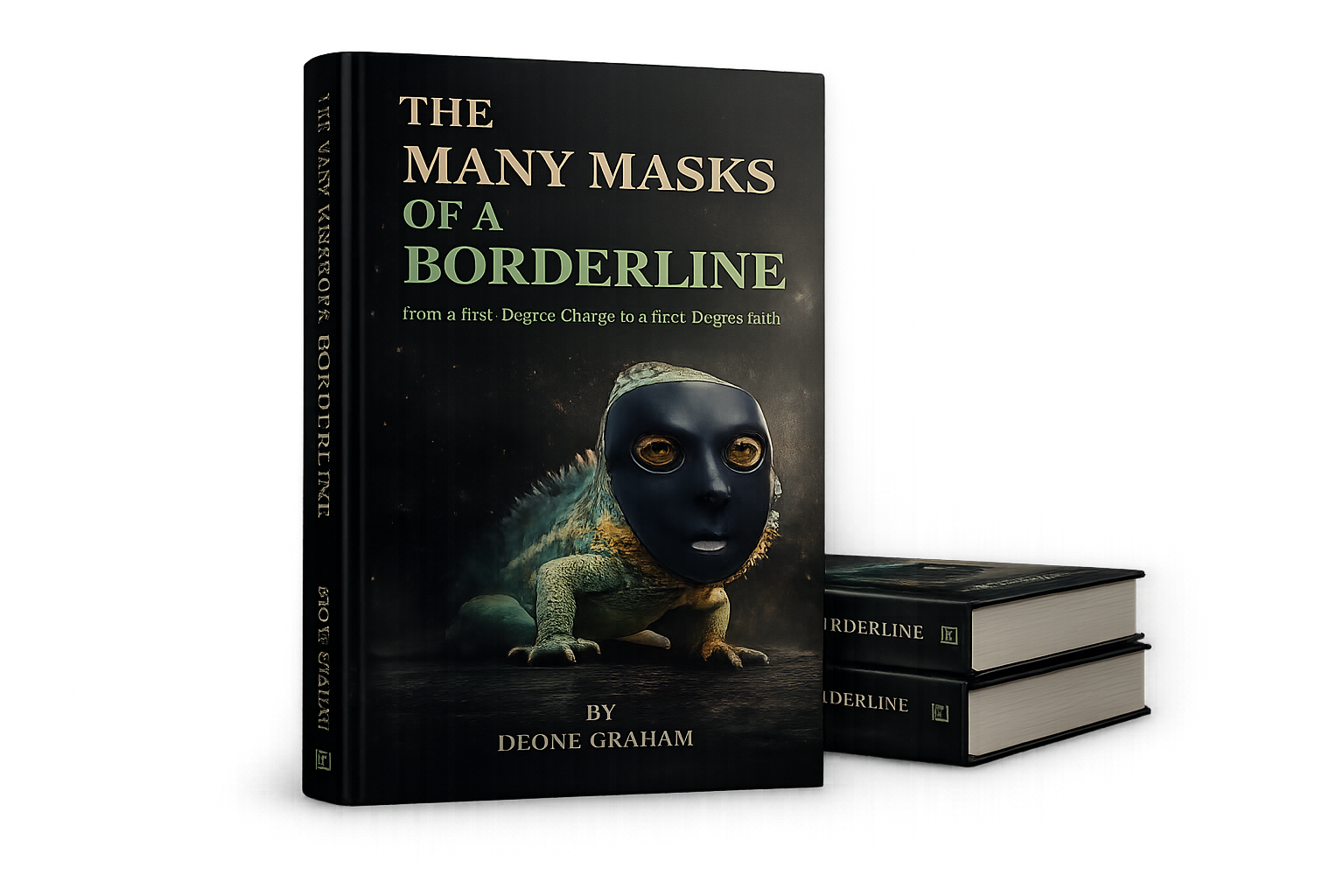
Featured Book
A dramatic journey from accusation to awakening, from hidden pain to a faith strong enough to face the truth.
The story moves with a cinematic pulse: shadowed rooms, difficult choices, spiritual endurance, and the question of who we become when every mask finally falls.
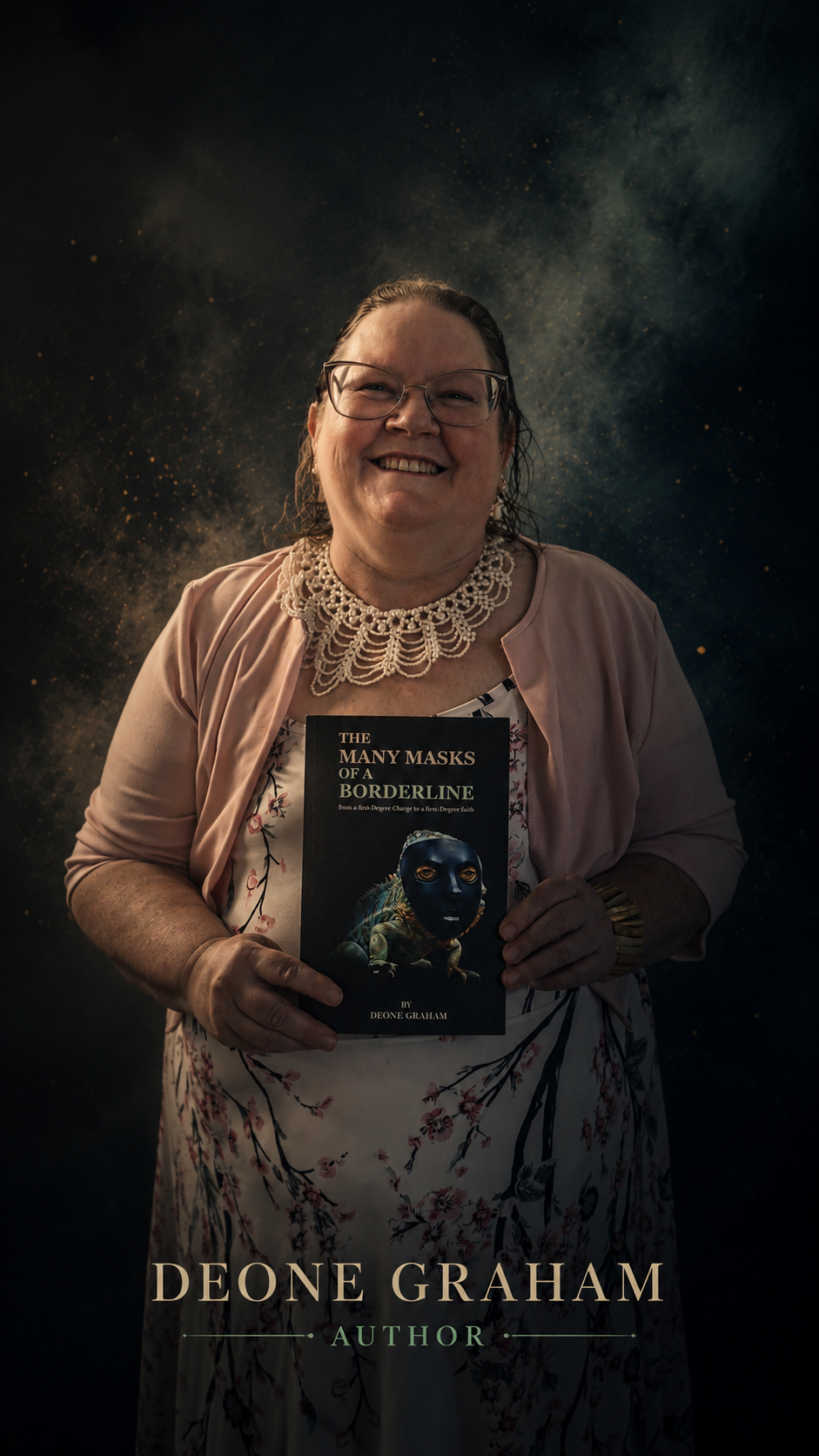
I’m Deone Graham, and this is my story.
This is not a story about perfection. It is a story about survival, relapse, regret, healing, and hope.
For most of her life, Deone Graham struggled with poor self-image, destructive relationships, alcoholism, and emotional pain that seemed impossible to escape. She believed she deserved less. She accepted abuse. She chased love in all the wrong places. Sex and alcohol became coping mechanisms. Numbing became normal.
Twice married. A mother of four. A grandmother and great-grandmother. And for years... absent.
This memoir is a raw and honest reflection of what it means to live with Borderline Personality Disorder, to walk through addiction, and to wake up one day realizing you want something different, even when you don’t know how to get there.
With courage and humility, Deone shares:
This book does not offer easy answers. It offers truth.
It speaks to anyone who has ever felt broken, behind, unlovable, or beyond saving. It reminds us that healing is not linear, growth is messy, and redemption is always possible.
At its heart, this is a story about choosing to keep going.
To anyone who feels like their story is already over: Keep stitching. The pattern isn’t finished yet.
If you or someone you love struggles with addiction, mental illness, trauma, or self-destructive patterns, this book offers understanding, validation, and hope.
You are not a monster in the dark. You are a human who can still find the light.
Free Chapters
Step into the opening chapters of The Many Masks of a Borderline.
Chapter 1
The noise doesn't start as a scream; it starts as a hum. It’s a low-frequency vibration, like a power line or a heartbeat you aren’t supposed to hear. In the band room, surrounded by the cacophony of sixty instruments tuning to a perfect, bright A, the hum is the only thing that sounds honest to me. It is my internal frequency, a jagged, relentless reminder that I am vibrating at a pitch the rest of the world can’t hear.
I sat in 2nd chair with my French horn in my hands and a storm in my chest. The metal was cold against my palms, a heavy, brass circle of armor. To play the horn, you have to be a statue. You have to control your breath, your lip, your very blood. But my emotions didn't have a dimmer switch. I was never “a little” anything. I was either a total white-out of feeling or a hollowed-out void, and right now, the storm was at full volume.
Next to me sat the boy who was 1st chair. He was the gold standard of a species I didn't belong to, the “Saved.” I watched the back of his neck, steady and still. He played with a grace that made me want to scream. He believed in the music, in the director, in the future. He was the melody; I was the feedback.
We sat so close that our elbows almost brushed, yet the distance between us was a canyon. He didn't turn around. He didn't look at me. To him, I was just part of the collective sound, a blur in his peripheral vision. He didn't know that there were two of us occupying my chair. There was the teenager in the polyester uniform, and then there was the four-year-old hiding behind the mask.
The ruined me was born at four years old. She was the one who learned that a voice was a liability, that screaming didn't bring help, it only deepened the silence. She sat behind the heavy curtain of my ribs, clutching the edges of my social mask with tiny, voiceless hands.
The director tapped his baton, and the room exploded into a wall of sound. I hit my notes, my fingers moving with a muscle memory that felt like a lie. I was so quiet that I was practically invisible. I was a master of the blur, a ghost note in a symphony of “normal” people. I realized then that I could disappear right out of my chair, and the music wouldn't even waver.
I was the species that hides when it’s hurt. The species that knows “nobody is coming to save me” isn't a sad thought, it’s a law of physics.
When the bell rang, the 1st chair boy packed his instrument with ease, confident hands. I remained in the shadows. I carried those shadows with me out of the room, through the crowded hallways, and into my next class. I sat in the back of the room, a ghost through a wall, watching the “Saved” species live their 3D lives while I waited for the next “Morning After” to prove me right.
The hum didn't stop. It just waited for the silence to return.
Chapter 2
At four years old, the world is supposed to be made of knees and tabletops. It is a world where you are always looking up, waiting for a hand to reach down and pull you into the light. I remember the day I stopped looking up.
The setting was a small trailer in Michigan, a cramped, metallic box that felt like it was holding its breath against the winter. In a trailer, the walls are thin enough to hear a heart break in the next room, but they were thick enough to keep me on the outside of everything that mattered.
The center of the universe wasn't me. It was my baby brother. He was the “Saved” species. He was loud, he was new, and he was the sun that my mother’s world revolved around.
I stood in the narrow hallway, a tiny person in a tiny space, clutching a secret or a question or a need. I don’t remember which, only that it felt like the most important thing I had ever owned. I reached out a hand to touch my mother’s sleeve as she hunched over him, her back a wall between me and the warmth.
“Not now,” she said. She didn't turn around. She didn't look to see the four-year-old face that was slowly losing its light. She was exhausted, her eyes fixed on the unbroken life in her arms.
“Not now” wasn't a yell; it was an erasure. To my four-year-old brain, it didn’t mean wait. It meant never. It meant that the air in the room was a finite resource, and I was breathing someone else’s share.
That was the moment the hum began. It started as a vibration in my feet, a low-frequency realization that I was a different species. I had a voice, but I saw then that it was a useless tool. If I screamed, it would just bounce off the wood-paneled walls and fall dead at my feet. Nobody was coming to save me because nobody knew I was drowning in the first place.
I pulled my hand back and did the only thing a ruined child knows how to do: I became a ghost. I retreated to the tiny, cramped corner behind the sofa, a space that was too small for anyone else to want. I sat there in the shadows, clutching a blanket that smelled like cold heaters and neglect, and I practiced my face. I smoothed the longing out of my eyes. I tightened my jaw. I forged the mask.
I learned that if you don't ask for anything, you can't be told “no.” If you make yourself invisible, you can't be rejected.
By the time the boy in the band room sat in his 1st chair, he was just another version of that baby brother, another effortless creature of the light. He didn't have to try to be seen; he just was. But I was the girl from the trailer. I was the one who had learned to stay in the shadows of the hallway.
I sat next to him in 2nd chair, my French horn heavy and cold, and I felt the four-year old inside me shift. She wasn't angry anymore. She was just a master of the blur. I didn't want the light. To have the light, I would have to believe that someone would catch me if I fell. I would have to believe my voice was worth the air it took to speak.
The director tapped his baton, and I lifted my horn. I put the mask back on, hiding the voiceless child behind the brass and the polyester. I was a ghost in the machine, hitting the notes, matching the pitch, and disappearing into the sound.
The hum rose to meet the music, and I finally let it swallow me whole. Because in the shadows, the fact that you are already ruined isn't a secret, it’s the only thing that’s real.
Chapter 3
When the noise in your head is loud enough, you start to believe that if you just move fast enough, you can outrun it. For 27 years, I was a ghost in my own life, running from the girl in the Kenosha band room.
I thought geography could cure a pathology. I didn’t realize that I was carrying the engine, that BPD diagnosis, inside me. No matter how many state lines I crossed or how many new lives I tried to start, the engine was always there, idling at a million miles per hour.
The Two Medicines: Liquor and Anger
To survive the run, I relied on two things to keep the noise at bay.
Liquor: This was the “drowner.” It was the only thing that could turn the volume down on the belief that I was unlovable. But the problem with drowning your sorrows is that they eventually learn how to swim.
Anger: If liquor was the anesthetic, anger was the armor. I hid my fear behind a wall of fire. If I were angry, I wasn’t vulnerable. If I were the one yelling, I wasn’t the one being abandoned.
This is a hallmark of the BPD “Fight” response. When you feel like you’re “already ruined,” you become a scorched-earth person. You blow up relationships, jobs, and opportunities because the anticipation of them failing is more painful than the act of destroying them yourself.
The Bottom Falling Out
The run finally ended in a prison cell. An F2 felony is a heavy thing to carry. It is the ultimate confirmation of the “ruined” identity.
In a halfway house, with a record and a history of chaos, the voice in my head was screaming: “See? We told you. You’re done. Nobody is coming to save you now.”
But here is the secret of the map: The bottom is often the only place where the ground is solid enough to start building.
In that cell, I couldn’t run anymore. I couldn’t drink. I couldn’t hide behind the mask because the mask had been shattered by the legal system.
Standing Still
For the first time since high school, I had to sit with the noise. It was deafening. But in the silence of that confinement, I started to realize that the “ruined” person was just a story I had been told by a malfunctioning brain.
The prison cell wasn’t the end of my life; it was the end of the run. It was where I finally stopped trying to be “normal” and started trying to be real.
Official Author Website
A bold new voice bringing testimony, suspense, and hard-won faith into the light.
Deone Graham writes with courage, conviction, and a storyteller's eye for the turning point.
Her work is rooted in lived struggle and spiritual perseverance, shaped for readers who believe that even the hardest chapters can become a witness.
With The Many Masks of a Borderline, Deone invites readers into a story of reckoning, resilience, and grace.
"Every mask tells a story. Every truth has a moment when it demands to be seen."
Reader Reviews
Reflections on The Many Masks of a Borderline and the impact of Deone Graham's story.
This is the story of one woman’s journey from feeling completely invalid to a diagnosis that saved her life. Deone Graham struggled with feeling literally invisible for most of her life, sorry for even taking up space, and it affected every aspect of her world. A world that not only felt foreign to her with its “Saved” people, but a world that saw only what she projected to them so that she could hide her true self.
Not knowing that she suffered from Borderline Personality Disorder (BPD), her life took a sudden and devastating plunge due to a misunderstanding. The resulting consequences would take her freedom, and change the course of everything, but some unexpected and positive outcomes would also emerge.
Deone shares what it’s like to navigate living through the lens of BPD, providing surprising insight and life lessons that are valid for people with or without mental health disorders.
I found quotes like: “…you cannot heal a wound that you are constantly hiding behind a mask”, and in reference to her drinking issues, “the problem with drowning your sorrows is that they eventually learn how to swim,” to be quite true and beautifully spoken, as well as the positive message, “I was making choices based on where I was going, not where I had been.”
The book does read a little like an unfinished draft, and I think it just needs to be fleshed out and expanded to connect the different segments more fluidly. It would perhaps answer some questions that weren’t addressed as well. For example, I’d have liked to hear more of her childhood and why she had not been diagnosed long before her later years. But the writing itself is beautifully done and her story, while heartbreaking, had me reading the entire book in one sitting.
I believe this book and Deone’s account of what she has gone through could help people who suffer from BPD, as well as those who live with other disorders. As she says when talking about the parallel of crocheting and not giving up,
“As I taught them how to count their stitches and pull the yarn through, I realized I was teaching them exactly what I had learned: If you drop a stitch, you don’t throw the whole thing away. You just rip it back and start the row again.”
Great book would recommend. Gives a good look into the authors life and what she had to go through.
There are so few books that come from those who've actually lived through the experience BPD. It's nice knowing (and reading about) other people are in the same boat as you. Some parts are difficult to read but all of it familiar and gives hope to those of us who are still trying to figure out our way.
Contact
For reader notes, event inquiries, interviews, or book requests, reach out through the form or connect directly on Facebook.
Message on FacebookGrab A Copy
Ask about availability, signed copies, and reader updates from Deone Graham.